Weekday Sourdough Without Babysitting the Dough
Most sourdough recipes are written as if you spend your entire Tuesday hovering near the kitchen counter every thirty minutes. Whenever I tried to squeeze those schedules around normal work hours, I ended up rushing bulk fermentation or baking at eleven at night.
After keeping weight and temperature notes in a pocket notebook all winter, I settled on a rhythm that asks for roughly fifteen minutes of hands-on work spread across two mornings.
Formula for one 850 g batard
| Ingredient | Weight | Baker’s % |
|---|---|---|
| Bread flour (around 12.5% protein) | 400 g | 80% |
| Whole wheat flour | 75 g | 15% |
| Dark rye flour | 25 g | 5% |
| Water (around 28°C in winter) | 360 g | 72% |
| Ripe levain (100% hydration) | 100 g | 20% |
| Fine sea salt | 10 g | 2% |
Dropping hydration from the trendy 80%+ range down to 72% was the single biggest quality-of-life improvement. With 20% whole grain in the mix, the dough feels supple rather than soupy, holds tension on the bench without bench flour clouds, and still opens up into an even, custardy crumb.
Three habits that mattered more than autolyse
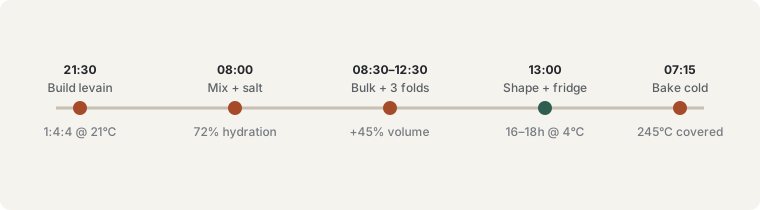
- A stiff-ish 1:4:4 overnight levain. Mixing 12 g starter with 48 g water and 48 g flour (half bread, half rye) around 21:30 peaks right around 08:00 at 20–21°C kitchen temperature. Skipping a separate flour-and-water autolyse and mixing everything—levain, salt, and all—at 08:00 produced loaves indistinguishable from my fussy two-stage batches.
- Watching volume in a straight-sided Cambro, not the clock. Kitchen temperatures swing between 18°C in January and 25°C in June. Marking the starting dough height with a piece of painter’s tape and shaping at roughly a 45% rise eliminated over-proofed pancakes when the weather warmed up.
- Baking straight from the 4°C shelf. A 5-quart cast-iron Dutch oven preheated at 245°C for forty minutes, 22 minutes lid-on with two ice cubes tucked beside the parchment sling, then 18 minutes uncovered at 220°C gives deep chestnut blisters without scorching the bottom crust (an empty sheet pan on the rack underneath shields direct radiant heat).
Wait at least ninety minutes on a wire rack before slicing; cutting into steaming crumb gums up the knife and lets out moisture that belongs in the loaf for the rest of the week.